Who Is Making Money in Ukraine in 2026?
When the term “Ukrainian market” comes up, people immediately picture news footage marked by conflict, power outages and pervasive uncertainty.
Most people’s perception of Ukraine’s e-commerce sector remains shaped solely by news reports, yet the reality tells a far different story.
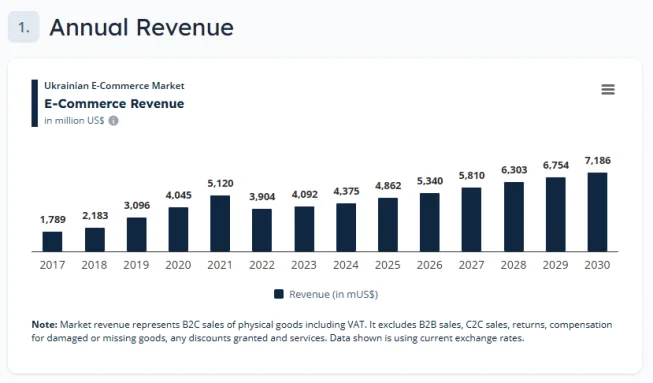
Ukraine’s online retail turnover hit 256 billion hryvnias (approximately 7 billion US dollars) in 2025, representing a year-on-year growth of nearly 7%. Internet penetration is projected to reach 80%, with around 36 million users accessing online services. Mobile commerce is expected to account for 45% of all e-commerce sales.
This means businesses entering the market right now are the trailblazers reaping first-mover advantages. By the time everyone deems the market “safe”, there will no longer be any room left for new entrants.
Back in June this year, the 5th Ukraine Reconstruction Conference (URC 2026) concluded in Gdańsk, Poland. The event drew over 9,000 participants and yielded 160 agreements worth a combined total of more than 10 billion euros. Behind these figures lies a nation that keeps functioning amid extraordinary circumstances and is accelerating its recovery. Within this large-scale reconstruction drive, the e-commerce industry has emerged as one of the most prominent growth engines, unlocking historic opportunities for the sector.
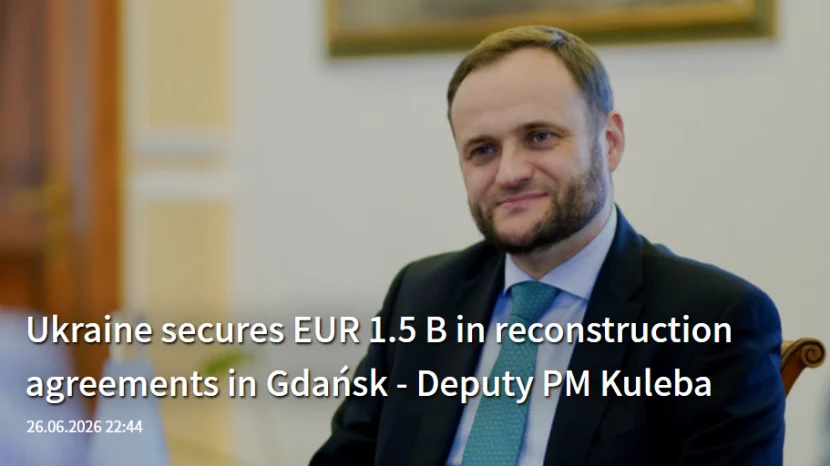
Image source: Internet
Equally noteworthy are the structural shifts reshaping the market. Ukraine’s internet penetration has surpassed 80%, with roughly 36 million users using online services. Mobile commerce accounts for nearly half of all e-commerce sales, and more than 55% of e-commerce traffic originates from smartphones. Digital payments make up over 60% of all online transactions. These metrics prove that Ukrainian consumers have fully entrenched online shopping habits. E-commerce is no longer an optional alternative, but an integral part of daily life. Forecasts indicate the market size will exceed 10 billion US dollars in 2026, cementing Ukraine’s position as one of Eastern Europe’s fastest-growing e-commerce hubs.
Heading into 2026, Ukraine’s e-commerce sector maintains moderate yet steady growth. Key market cities include Kyiv, Lviv and Odesa. Industry research shows total online retail revenue reached around 256 billion Ukrainian hryvnias (roughly 7 billion US dollars) in 2025, with a year-on-year growth rate of nearly 7%. Separately, research from ECDB puts average annual online revenue per user at 4,862 US dollars in 2025, with a sustained upward long-term trend.
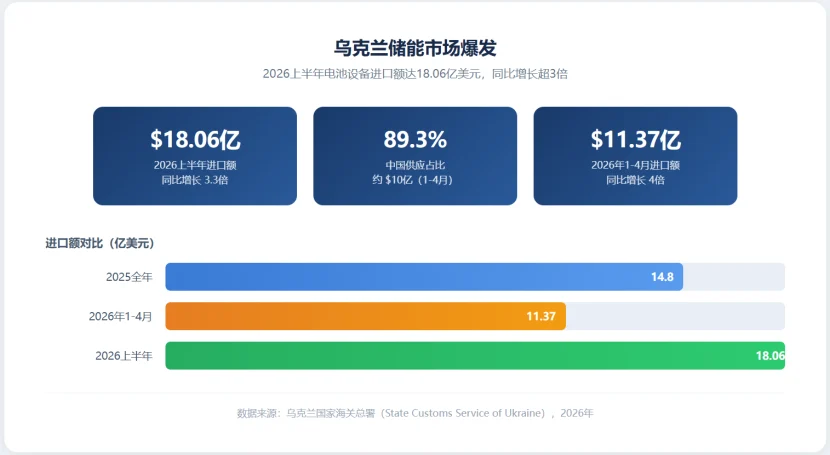
China’s total exports to Ukraine from January to April 2026 stood at 1.7917077 billion US dollars, an increase of 440.4132 million US dollars compared with the same period last year, marking a 32.6% year-on-year rise.
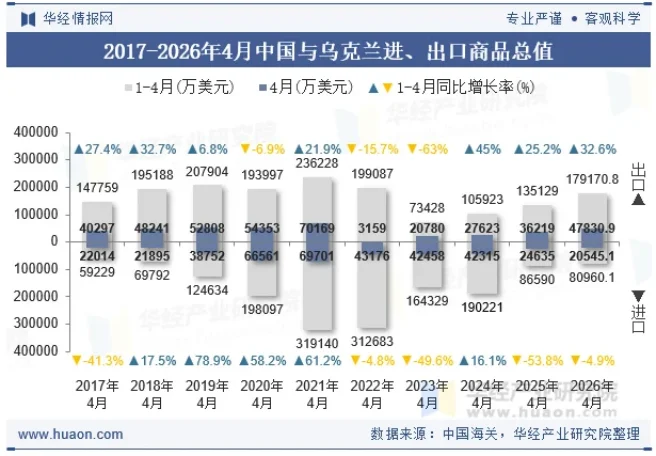
Image source: Internet
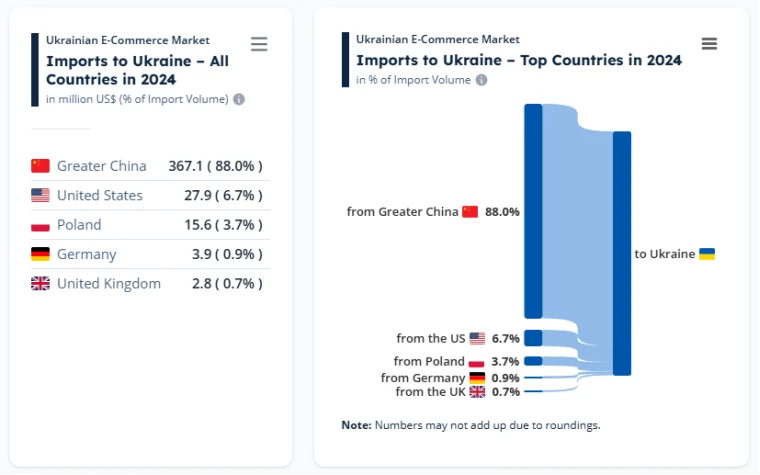
China is officially and mutually confirmed by both sides as Ukraine’s largest trading partner.
Domestic Giants Expand, International Players Step In
Rozetka stands as the undisputed leader of Ukraine’s e-commerce market, holding a commanding lead in market share, user base and website traffic. In the first nine months of 2025, subsidiaries under the group generated a combined revenue of 30.2 billion hryvnias (approximately 687,178 thousand US dollars), accounting for 76% of total revenue from Ukraine’s top ten online retailers. Yet Chinese sellers make up less than 5% of its merchant base — the massive untapped potential of the market speaks for itself.
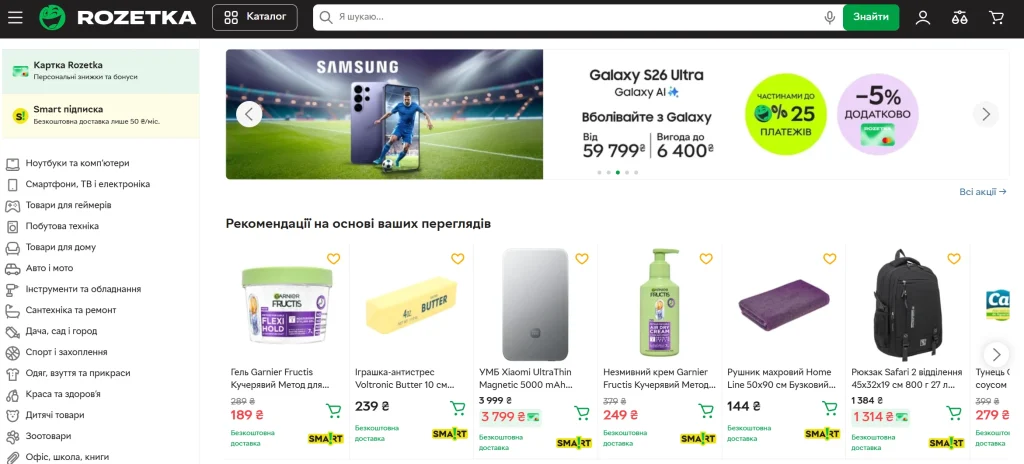
AliExpress remains widely popular among local shoppers. Allegro, Poland’s largest e-commerce platform, plans to launch its Ukrainian operations in summer 2026. Its first phase will launch direct shipping of Polish goods to Ukraine, with plans to roll out the Allegro.ua domain and onboard local Ukrainian sellers in 2027.
Ukrainian consumers tend to prioritize local merchants, especially when fast delivery is a top priority.
From Waiting and Watching to Taking Action
In early April 2026, Rozetka officially signed a cross-border e-commerce Memorandum of Understanding with Meest China. Meest China became Rozetka’s exclusive partner in China, tasked with sourcing and onboarding Chinese sellers and suppliers.
During the project’s first phase, the Rozetka platform will introduce over 1.2 million product lines from Chinese suppliers, covering high-demand categories including home goods, consumer electronics, hardware and daily necessities. The lineup also includes around 400,000 branded products renowned for premium manufacturing standards and competitive pricing.
Also in April, the Consulate General of Ukraine in Guangzhou hosted a special delegation. Diplomats from the consulate held negotiations with representatives from 12 Chinese enterprises that had previously submitted cooperation proposals to Ukrainian diplomatic missions.
According to official statements from the consulate, these enterprises span trade, logistics, construction, design engineering and manufacturing. Their shared objective is clear: to form a joint delegation for an inspection trip to Ukraine, where they will assess the investment landscape, security conditions and relevant laws and regulations, and hold talks with representatives of Ukraine’s government and private sector.
Chinese private enterprises have identified enormous untapped potential in Ukraine’s post-war reconstruction construction and trade sectors, and are eager to secure a foothold in these high-growth fields.
While business owners conduct field inspections, cross-platform cooperation agreements have already been put into effect.
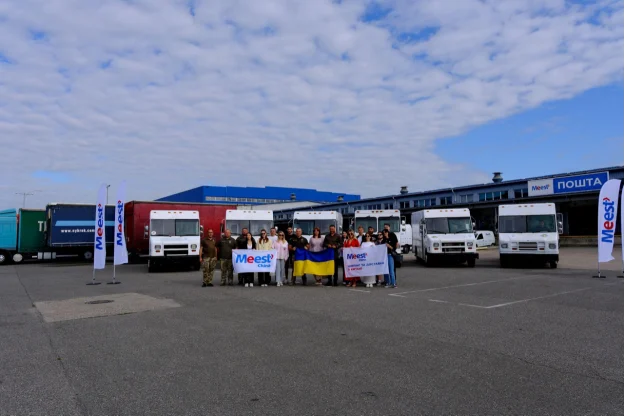
Everyone knows Ukraine holds great business potential.
The divide between those who take concrete action and those who only stand by and watch is not about courage, but timing.
Chinese e-commerce players have undergone a fundamental shift in their stance toward the Ukrainian market: the question is no longer “Should we enter?” but “How do we enter?”
Opportunities always favour those who lay groundwork in advance.
Why wait until others have fully paved the way before you step in?
Ukraine’s Logistics Backbone
Logistics is the linchpin of Ukraine’s e-commerce industry in 2026. Today’s shoppers demand far more than basic delivery; they want fast transit, full shipment tracking visibility and flexible pickup options. Door-to-door delivery is no longer the sole focus — parcel lockers and self-pickup points are the unsung heroes, perfectly catering to consumers’ preference for convenient, on-the-go collection.
Meest plays a pivotal role in last-mile delivery. The company has processed record volumes of parcels recently and continues to expand its service network, boasting more than 25,000 self-pickup locations with near-universal delivery coverage.
It is also constructing a $30 million logistics hub near Lviv, designed to process one million parcels daily. Logistics group GOL will build a Class A logistics centre spanning 13,500 square metres in the Zakarpattia Oblast.
To sum up Ukraine’s e-commerce landscape in 2026 in three words: resilient, fast-growing, diversified.
Many once dismissed Ukraine as a war-torn country, yet viewed from a commercial perspective: with reconstruction demand valued at 486 billion US dollars, 11.5 million active e-commerce users, and annual market growth exceeding 20%, this is far from a niche opportunity.
More importantly, the barriers to entry may be lower than many assume. The key is securing a reliable local partner with expertise in policy compliance, customs clearance, warehousing and platform integration.
As one Chinese industry participant attending a trade exhibition in Kyiv put it: “The Ukrainian market does not lack capital; it lacks proper operation.”
Now, Chinese businesses are stepping forward to fill this operational gap with tangible actions.